

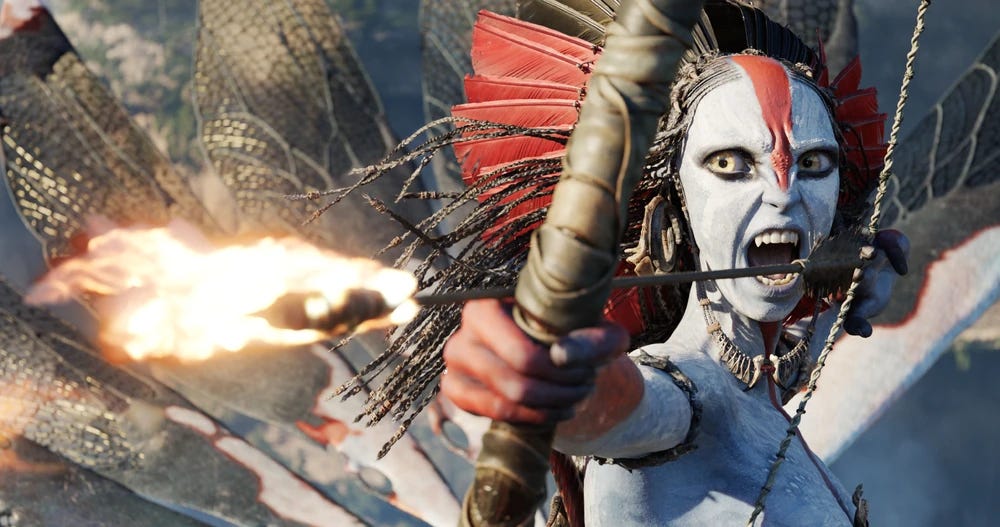
The bad news about Avatar: Fire and Ash is that for the first time in his entirely singular career, director James Cameron has delivered something that can credibly be described as ‘more of the same.’ If you were hoping for another Avatar film as innovative and distinct as 2022’s The Way of Water – a film I loved at the time, and have only come to consider more remarkable in the three years since – Fire and Ash is, unfortunately, not that. This is an extremely direct follow-up to The Way of Water that continues all of the conflicts and character arcs from the second film, without offering all that much that’s purely new. We don’t go to a new biome of Pandora, and the new antagonist featured front and center in the marketing – Varang, played by an outstanding Oona Chaplin – does not shake up the status quo in any notable way, serving instead as a new tertiary antagonist behind Stephen Lang’s Col. Miles Quaritch and the human race as a whole. Ultimately, Fire and Ash is still working within the same thematic and narrative framework as its predecessor, albeit with a much more misshapen structure: an extremely propulsive and virtuosic first hour, featuring some of the greatest action direction and visual spectacle of Cameron’s career thanks to an airborne battle on and around the Jellyfish-like airships of Pandora’s Wind Trader tribe, gives way to a significantly more muddled second and third hour, which struggle to keep a sense of forward momentum. The big action climax is reliably impressive, but also very repetitive of dynamics from the all-time great climax to The Way of Water, and by the time it all wraps up – at a run-time clocking in two minutes longer than Cameron’s Titanic – Fire and Ash never manages to forge an identity for itself outside the shadow of its predecessor.
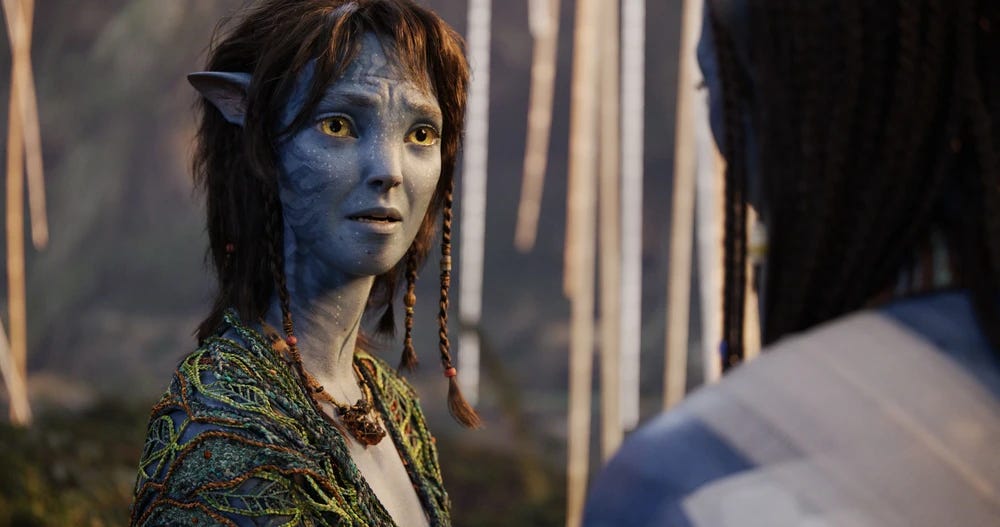
The good news about Avatar: Fire and Ash, though, is that ‘more of the same’ still means ‘more of a sequel I found impossibly rich the first time around, brought to life by some of the greatest and most awe-inspiring film craft in the history of the medium.’ For all its shortcomings, Fire and Ash is still a compelling – and wholly immersive – deep dive into a world I very much enjoy spending time in, especially with the expanded cast and richer dynamics brought to the fore in The Way of Water. If you were surprised at how much more interesting a protagonist Jake Sully turned out to be once he became a father, you’ll be even more impressed here, as he struggles with the death of his eldest son in the previous movie and weighs many heavy choices surrounding his dual roles as a leader and a dad (it bears underlining how far actor Sam Worthington has come – his performance here is genuinely excellent and startlingly mature from start to finish). If you thought The Way of Water sold Zoe Saldaña’s Neytiri short amidst all the new characters, Fire and Ash gives her quite a bit more to do, and really lets Saldaña stretch her legs as one of the most impressive physical performers of the 21st century. If you liked the absolutely crazy conceit of septuagenarian Sigourney Weaver playing her own teenage Na’vi daughter – Kiri, whose mysterious relationship to the spiritual network undergirding Pandora shapes much of the action here – then Fire and Ash is a rewarding watch just to see Weaver flesh this stunt out into a full-fledged, wonderfully effective performance. And if you thought the Tulkun (Pandora’s lovable pacifist space whales) were the coolest addition to the sci-fi creature canon of the last 20 years, well, buckle up, because Payakan and friends are back with a vengeance, and they once again rocked my fucking world.
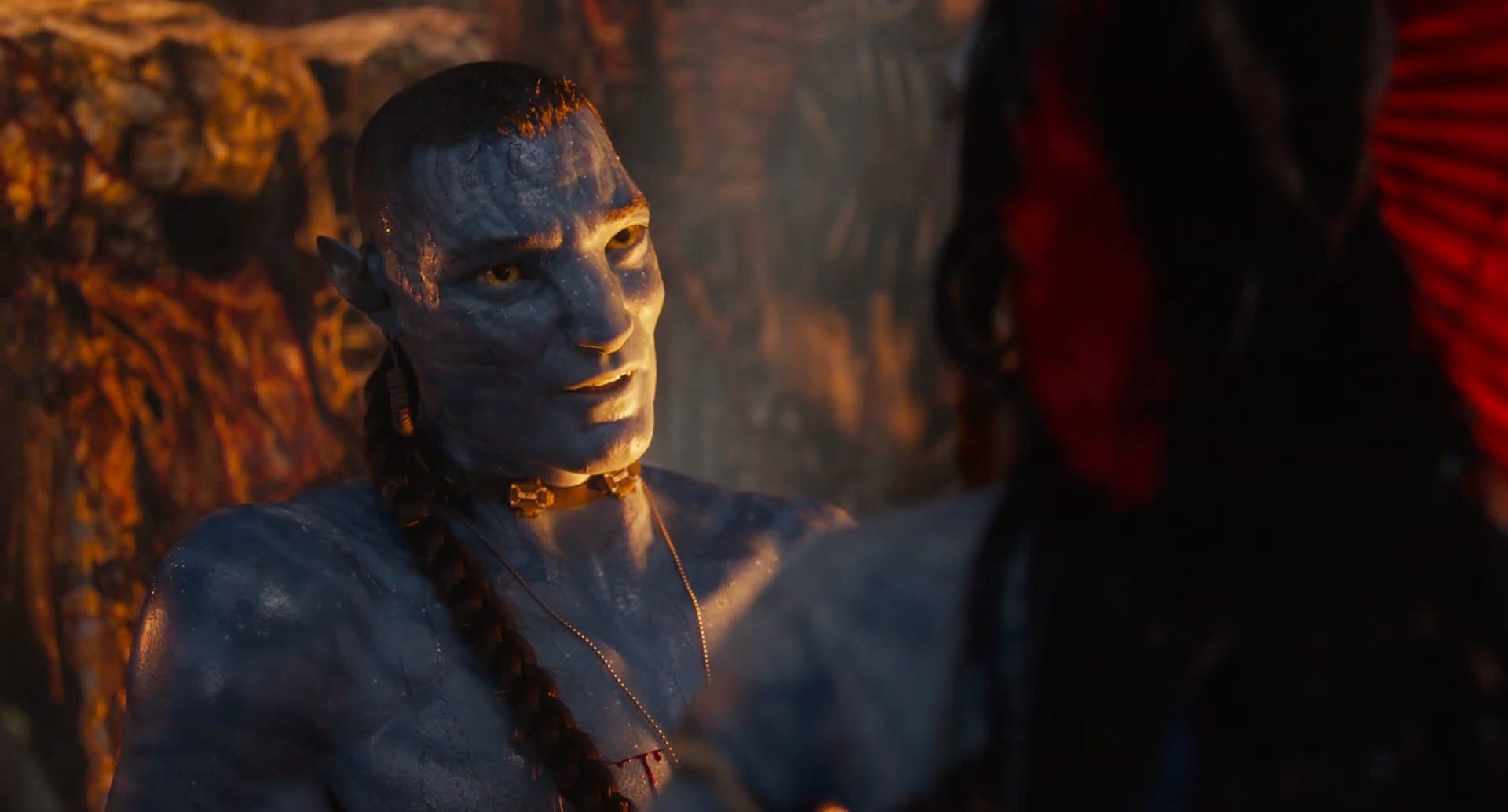
Perhaps most importantly, if you, like me, loved what Cameron and Lang did with Miles Quaritch in the second movie – plopping this deliciously one-dimensional 80s bad guy pastiche into a body that demands a massive existential quandary, thus making him instantly and unmistakably three-dimensional – then Fire and Ash is going to put a big goofy grin on your face. Miles basically has the human-Marine-resurrected-in-the-body-of-a-big-blue-space-alien equivalent of a midlife crisis in this movie, getting himself a crazy new girlfriend, a bold new look, and an increasingly devil-may-care attitude, and yet, like most men undergoing a midlife crisis, he doesn’t actually stop to change any of the fundamental behavior that makes him such a miserable bastard. So while it is funny to try keeping count of just how many times Miles takes various friends and family members of Jake Sully hostage in order to force his enemy to surrender, this is one area where I think Cameron is onto something when Fire and Ash rhymes or repeats events from The Way of Water. Simply put, it’s interesting when a character this fundamentally loony keeps going through motions he has no logical reason to repeat any longer. And just about anything is interesting when the great Stephen Lang is the one doing it, though his work in these films is so special that I wholeheartedly believe the Academy Awards should give him a special, blue-colored Oscar statue for his work across these three films.
If Fire and Ash can be said to have a clear, unifying theme differentiating it from the first two movies, it is an investment in the concepts of faith and spirituality that have always been part of the texture of Pandora, but are here brought to the fore. Jake questions the benevolence of the Goddess Eywa, while Neytiri clings tight to her faith; Varang denounces Eywa and kills her fellow Na’vi after feeling abandoned by her God, while Kiri nearly destroys herself trying to commune with a deity who is seemingly shutting her out. And lest one think Cameron is only treating this material as window dressing, there are multiple extended sequences connecting Na’vi spirituality to Christian theology, including a full-on virgin birth allegory and the most direct recreation of Abraham’s son-killing test in Genesis I have ever seen in a Hollywood blockbuster. Cameron doesn’t pull all these threads together as tightly as he probably should – the film’s single biggest problem is how Varang gets left behind in the final hour, her perspective on all this feeling conspicuously absent – but there are all kinds of provocative ideas and productive tensions on display here, with Kiri’s story in particular building to one of the wildest images of Cameron’s entire career (a call-and-response, of sorts, to the most famous image from Stanley Kubrick’s 2001).
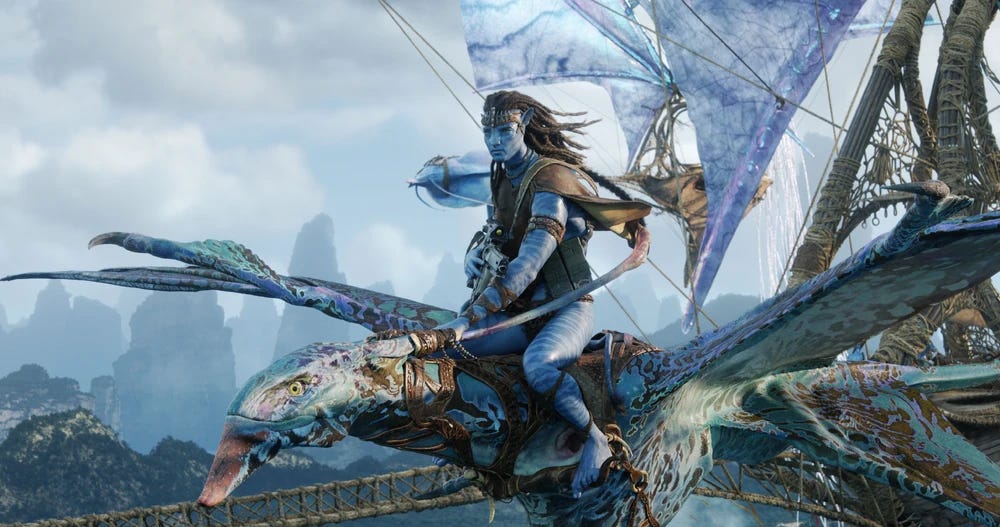
And then there is the entire technical dimension of the film, which is once again operating at a level many heads and shoulders above anything else in Hollywood, and which frankly feels like it’s being beamed in from many decades in the future. Avatar remains a powerful out-of-body experience, and at this point, there is exactly zero daylight between the visual effects and an overwhelming sense of verisimilitude. Every Na’vi looks like a real person with make-up and prosthetics more than they do a CGI creation, and their interactions with water, textures, surfaces, and even real, photographed human beings – like Spider (Jack Champion), the lone human body on-screen for long stretches of the movie – is absolutely seamless. One cannot find a single point, across 197 minutes, where the visuals even mildly fail to pass the smell test. This is a film where we spend over three hours looking at impossible things, and absolutely none of it bears any signs of trickery.
I understand the temptation some critics have to treat all this as merely ‘incidental,’ but I think that’s deeply misguided. I kept reflecting, watching Fire and Ash, on what a stunning celebration of human artistry this movie is, in an age where the scam that is generative AI keeps trying to devalue the very idea of art itself. Cameron and his team have spent literal decades honing their technology to get to this point, but it’s all in service of emphasizing the fundamental human qualities of the work, not effacing it. The visual effects behind the Na’vi aren’t impressive because they’re creating something out of nothing, but because they’re used to translate real human performance into these impossible bodies.
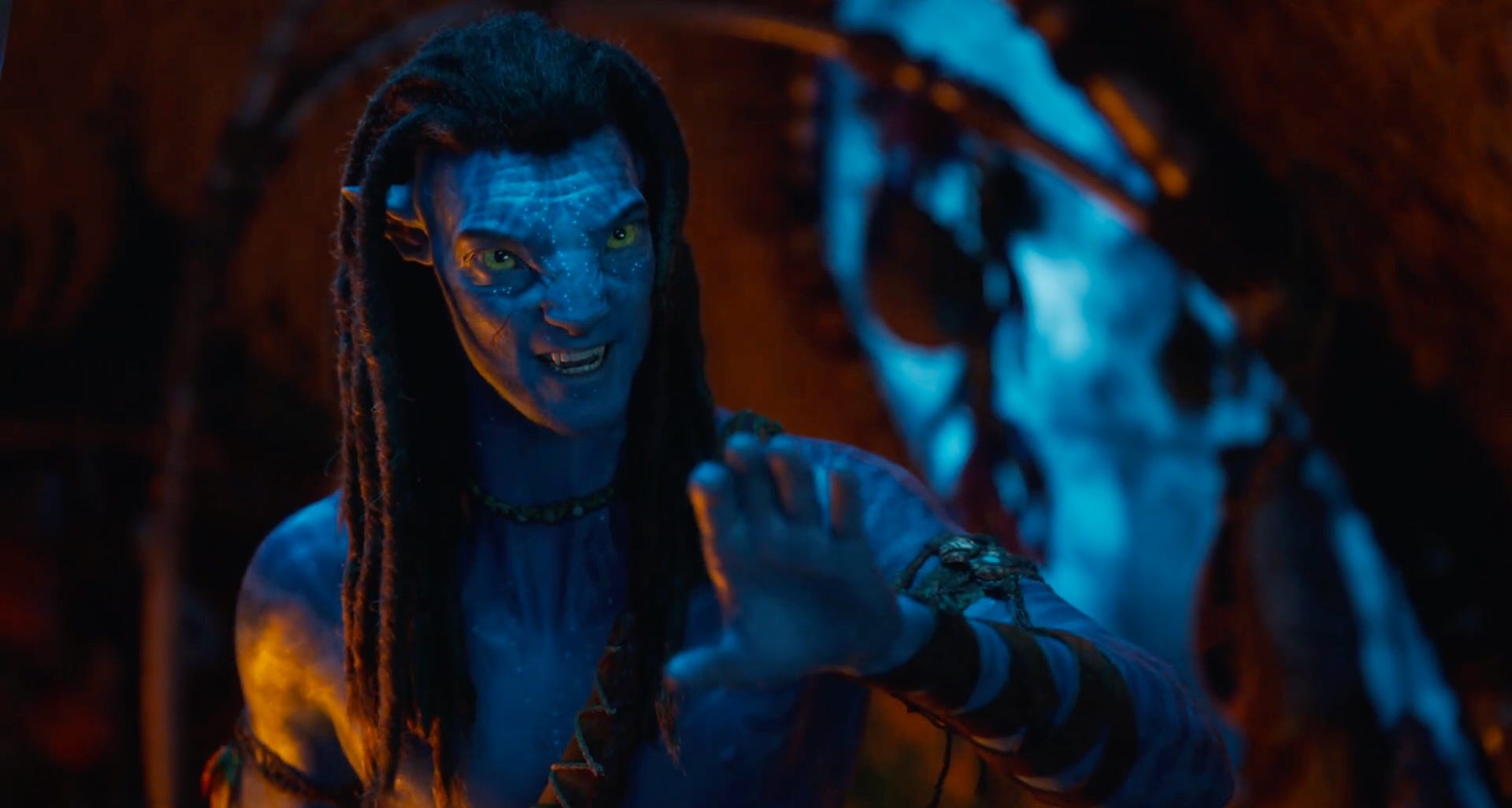
There is a stunning pair of scenes around the halfway point of Fire and Ash – one involving Jake and Neytiri discussing the depths of their ‘hate’ for humanity, the other following their son Lo’ak at his lowest point, as he nearly attempts suicide – and they aren’t remarkable because of the effects, but because of the humanity shining through the spectacle: the careful, surprisingly tender character writing; the raw, incredibly committed performances from Worthington, Saldaña, and Britain Dalton; the evocative evening lighting and intimate handheld camerawork. Nothing we’re actually looking at in these scenes is technically ‘real,’ in a profilmic sense: it’s all ones-and-zeroes, digital images conjured in a computer. But those digital images are transmitting human art, and they’re doing it so flawlessly that we do not for one second question the reality of what is before us. We’re not watching CGI animation: we’re watching Sam Worthington and Zoe Saldaña, the entirety of their great, nuanced performances transported intact across the chasm of special effects. That’s the miracle at work here. That’s the breakthrough Cameron has made, and it’s what makes Avatar worth celebrating even when there are problems in the story or script. Style is not separable from substance, and to me, the fact that Cameron and company have honed a style that brings to bear so much stunning human artistry to create a wholly immersive fantasy world means there is an awful lot of substance on display here.
One last note: I saw Fire and Ash in Dolby Cinema 3D (which Cameron himself has said is his preferred presentation), and it is, hands down, the best 3D presentation I have ever seen, even a notch or two above what The Way of Watermanaged three years ago. Cameron has stuck with the questionable choice to blend high frame rate (48 frames-per-second) footage with standard 24 fps, and it’s still the lone technical hiccup on display here, because while the 48fps sections are incredible, the switches back down to 24fps are always awkward and jarring. But a much higher percentage of the film is at that higher frame rate this time around – all of it making a compelling case that higher frame rates should be played with more often, at least in the blockbuster spectacle space – and the 3D is absolutely perfect. There is no ghosting, no crosstalk, no blur of any kind. The image is so vivid and vibrant that you start to forget the glasses are even there. And in 197 minutes, I did not feel a single ounce of eye strain. It really is marvelous, and whatever imperfections the film has on a narrative or structural level, I’m already excited to go see it once again just to appreciate it as a once-in-a-lifetime visual tour-de-force. Nobody else in Hollywood is pushing the envelope even a fraction as hard as Cameron is, and we should appreciate this commitment to technical excellence while we can.

If, for some bizarre reason, Fire and Ash underperforms at the box-office and we never get the planned fourth and fifth Avatar movies that are already written (and, in the case of the fourth film, partially shot), this third installment does bring enough narrative closure to make it an acceptable end to the story. But even with some of the repetition and structural missteps on display here, I walked away from my three-and-a-half hours with Fire and Ash wanting more. I want to see Cameron spin up another truly new story in this world; I want to see Jake and Neytiri’s kids fully grow up, and what kind of adventures they find themselves on when they’re at the center of things; I especially want to see where Miles Quaritch goes from here, now that this phase of his cuckoo-bananas character arc has come to a close. And goddammit, I want to see James Cameron continue to spend hundreds of millions of dollars of Disney’s money innovating on this mind-boggling, totally transformative scale. Three years ago, I walked into The Way of aWater an Avatar skeptic; today, I step out of Fire and Ash feeling firmly like a fan. I love these movies, warts and all, and if Cameron is up for giving us more, I’ll be there day one.
Read the book 200 Reviews by Jonathan R. Lack in Paperback or on Kindle
Subscribe to PURELY ACADEMIC, our monthly variety podcast about movies, video games, TV, and more
Like anime? Listen to the podcast I host with Sean Chapman, JAPANIMATION STATION, where we review all sorts of anime every week. Watch on YouTube or Subscribe wherever you get your podcasts.
hi there, I really enjoyed your review. Even if I'm not agreeing with everything , for instance, Aliens and Terminator 2 are great great movies for me. And also the repetitive aspects of the scenario of Fire and Ash didnt bother me a second. I totally enjoyed the movie, breathtaking from beginning to end, much more complex, subtile, plenty grey areas, not just good guys on one side, the bad one on the other. For me, it is the best of the three. But you description of what make the qualities and the values of the movie, are so accurate, so complete, I didnt find another review through the net I enjoyed so much reading as yours. Thanks again
Hello Jon, We are also fans and enjoyed your review. We recently saw a documentary about Cameron’s motion capture techniques. So f-ing cool! 😎