

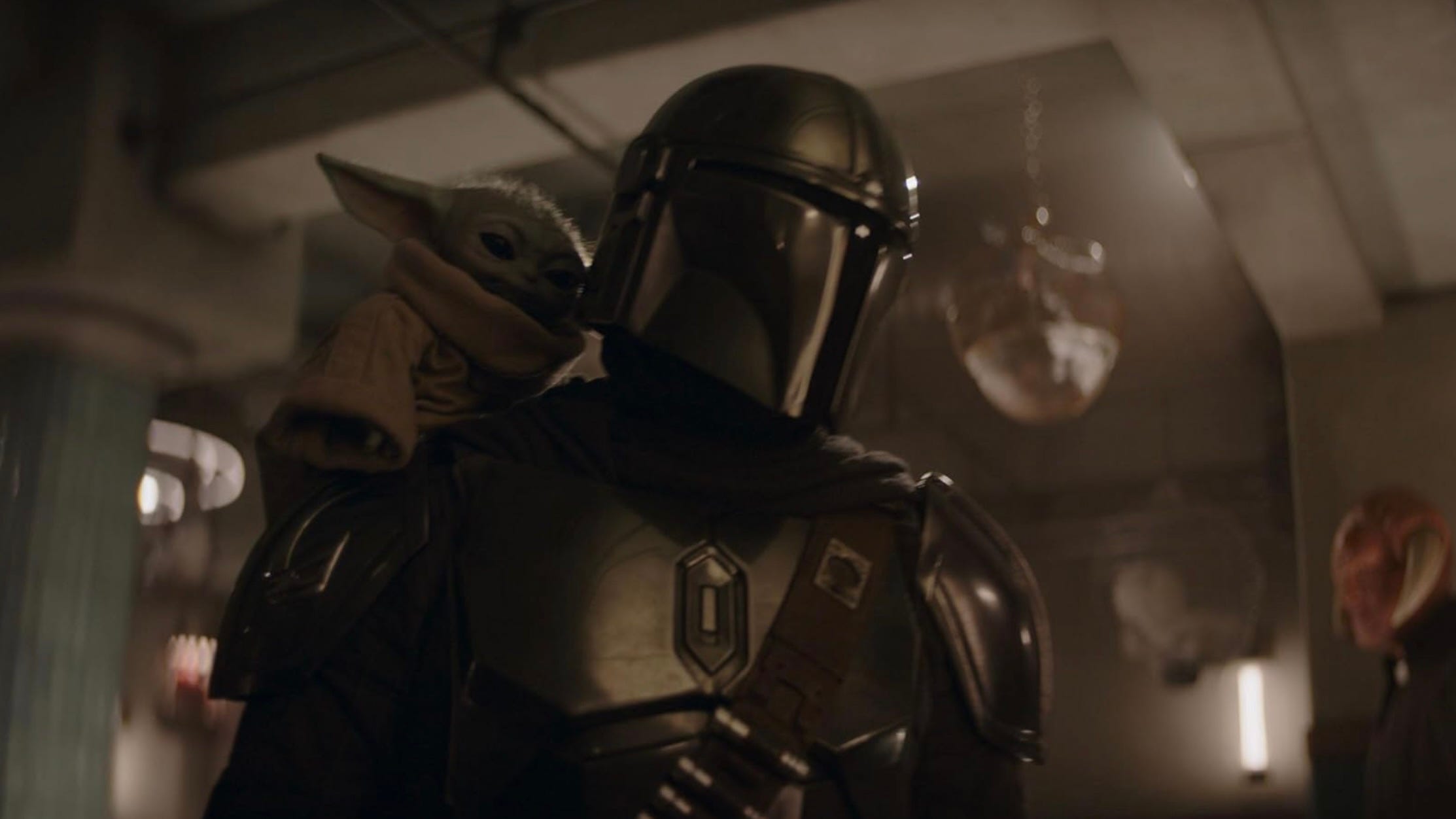
At this point, Star Wars is, I think it is safe to say, too big for its own good. It looms too large in popular culture, commands too high a budget and commercial expectations, has expanded too far in its number of central works and amount of accumulated lore. Once Lucasfilm, under Disney, opened the Pandora’s Box of live-action spin-offs for film and television outside the core ‘Skywalker Saga,’ they all but ensured we would reach this point, where the franchise has atomized to such a degree that no new Star Wars film can adequately shoulder the aggregate burden of what Star Wars is to all people. There will never again be a Star Wars event on the scale of The Empire Strikes Back or Revenge of the Sith, a monocultural object that mass audiences will see, debate, and love or hate on a relatively even playing field, working from a largely shared set of Star Wars experiences and expectations. Those days are gone.
Jon Favreau’s The Mandalorian and Grogu arrives carrying the unfortunate weight of being ‘the first Star Wars film in seven years,’ and the first since the unmitigated creative disaster of J.J. Abrams’ The Rise of Skywalker. Perhaps the highest praise I can lend the film is that it feels admirably unburdened from trying to live up to whatever impossible expectations those facts imbue it with. This is the first live-action Star Wars film that seems to arrive with the knowledge that Star Wars is no longer monocultural1: that there is no one singular ‘Star Wars,’ and no one singular ‘audience’ for the ongoing space opera. Rather than fighting against that reality, the film accepts it: this is not the next Star Wars movie, but a theatrical extension of The Mandalorian TV series. You will either be on board for that or you won’t be; such is the reality of the franchise’s cultural atomization. I for one found it rather refreshing.
After all, The Mandalorian itself has been fighting against its own place within the Star Wars landscape ever since Luke Skywalker’s CGI doppelganger walked on screen in the season 2 finale. For its first 15 episodes, The Mandalorian felt like a breath of fresh air precisely because it was not trying to shoulder the burden of being ‘all Star Wars for all people.’ It wasn’t a space opera, but a space Western procedural, a Lone Wolf and Cub riff about a bounty hunter and his adorable ward, neither of whom had special blood or were destined to save the galaxy. Its production values were outsized even for the streaming age of television, but its ambitions were refreshingly modest. No Sith, no Jedi, no homework required – just a cool man-with-no-name archetype, his awesome little puppet sidekick, and a new adventure with an increasingly endearing set of oddball supporting characters each week. It rocked.
When Luke Skywalker showed up in the 16th episode, it was, inevitably, a pivot point; as the end of Mando and Grogu’s journey together – Luke had shown up to take Grogu into his care – the cameo could, perhaps, be justified. Mando went on a journey, briefly brushed against the central spine of the Star Wars universe, and then the journey ended. That could work. Instead, it was a Big Bang-style point of rapid expansion. The next Mandalorian season wasn’t called The Mandalorian at all: it was The Book of Boba Fett, and it involved not only a bunch of characters from the Original Trilogy – including Luke and the eponymous Boba – but a number of characters and degree of lore from the hundreds of episodes of animated Star Wars television – namely The Clone Wars and Rebels – overseen by Dave Filoni. The Book of Boba Fett inaugurated a new era of Star Wars where no matter the title of the show, everything was part of the larger ongoing mega-narrative: Boba Fett, Ahsoka, The Bad Batch, Skeleton Crew, and more were less discrete works under the Star Wars umbrella than consecutive seasons of an endless Star Wars soap opera. Even The Mandalorian, when it came back for season 3, wasn’t really The Mandalorian anymore; it was another spin-off season – The Book of Bo-Katan – where Mando and Grogu were supporting characters in a much grander narrative.2 Star Wars had, indeed, gotten too big – so big that every individual piece began to buckle under its collective weight.
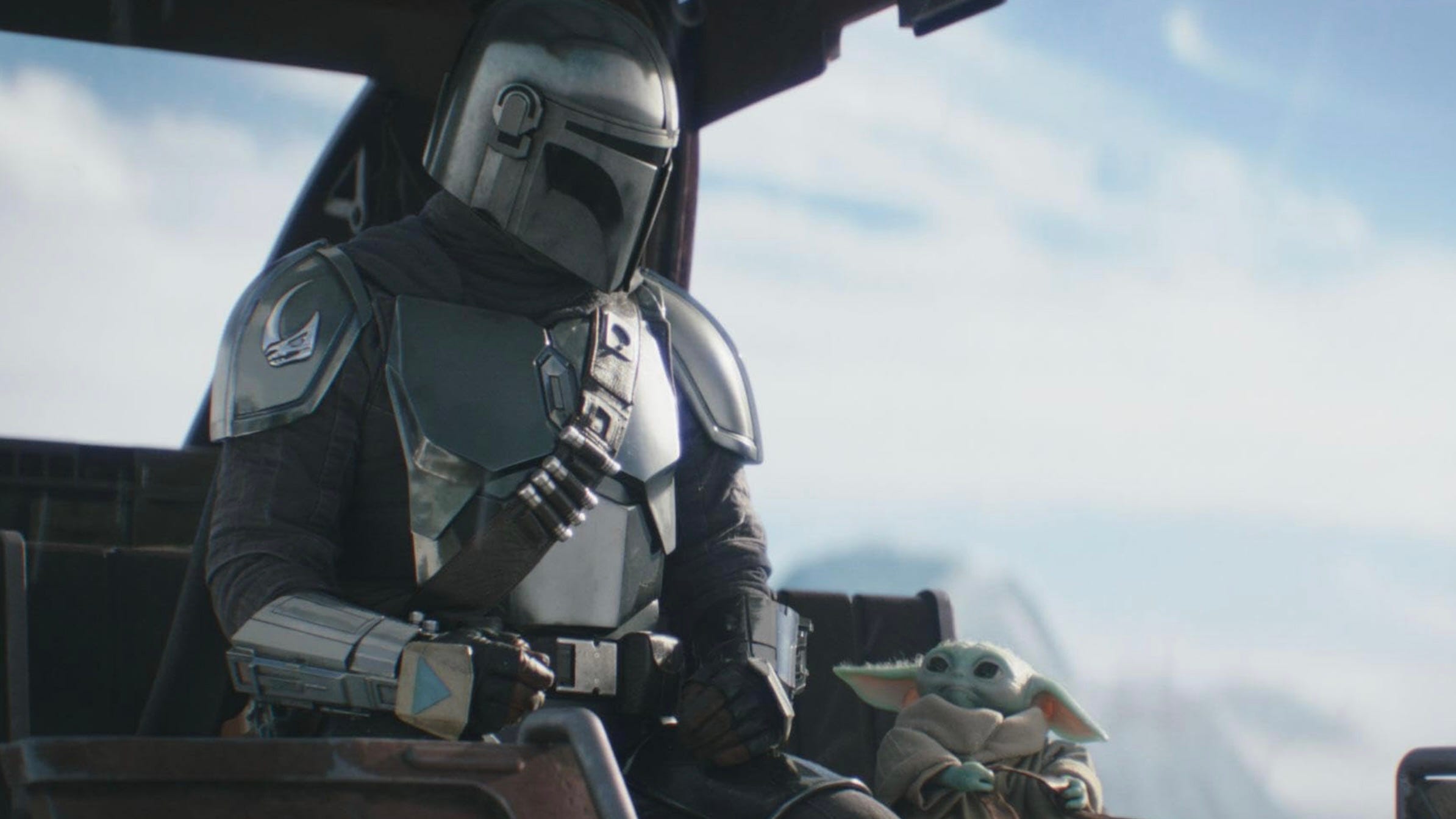
I offer all of this as context to argue that The Mandalorian and Grogu may in fact be a necessary corrective. I liked the film, in some ways quite a bit, and I think I liked it for some of the very same reasons other critics are chafing against it. This is not The Mandalorian as a central pillar of the grand Star Wars cathedral: this is The Mandalorian as we initially met him, in a procedural ‘mission-of-the-week’ story. Mando and Grogu are front and center, there is no concern shown for any of the lore or stakes of the larger Star Wars universe beyond them, and in its place is an understated but meaningful character arc that pushes the main duo’s relationship forward.
It is, in short, a back-to-basics affair: Mando (aka Din Djarin, voiced by Pedro Pascal but physically embodied by Brendan Wayne and Lateef Crowder, who are at last properly credited alongside the movie star) picks up a job, meets some interesting characters (including Rotta the Hut, son of Jabba, voiced by Jeremy Allen White and absolutely jacked), and engages in some fun action scenes that play with the show’s various genre influences (mainly Westerns and Samurai films – anything descended from Kurosawa’s Yojimbo). By the end, Mando and Grogu’s parent/child relationship has evolved a little bit. To me, that’s enough. I am absolutely fine with this being, as many have called it, a ‘big episode of the TV series.’ That’s a good thing, especially since the TV series itself spent its last two seasons trying to be anything other than what viewers initially loved, and became a disappointing garbled bore as a result. Maybe it’s the anime viewer in me, who is plenty used to movies that are TV series extensions; it’s still unusual in Hollywood, but Japanese animation is chock full of franchise films that offer standalone stories set in the story’s world but not invested in driving that entire world forward. For my tastes, this is the right kind of ‘expanded episode on the big screen;’ it’s less about the extra scope or budget afforded the production than the extra time, and the focused space of the theater helping to coalesce ideas in a single direction.
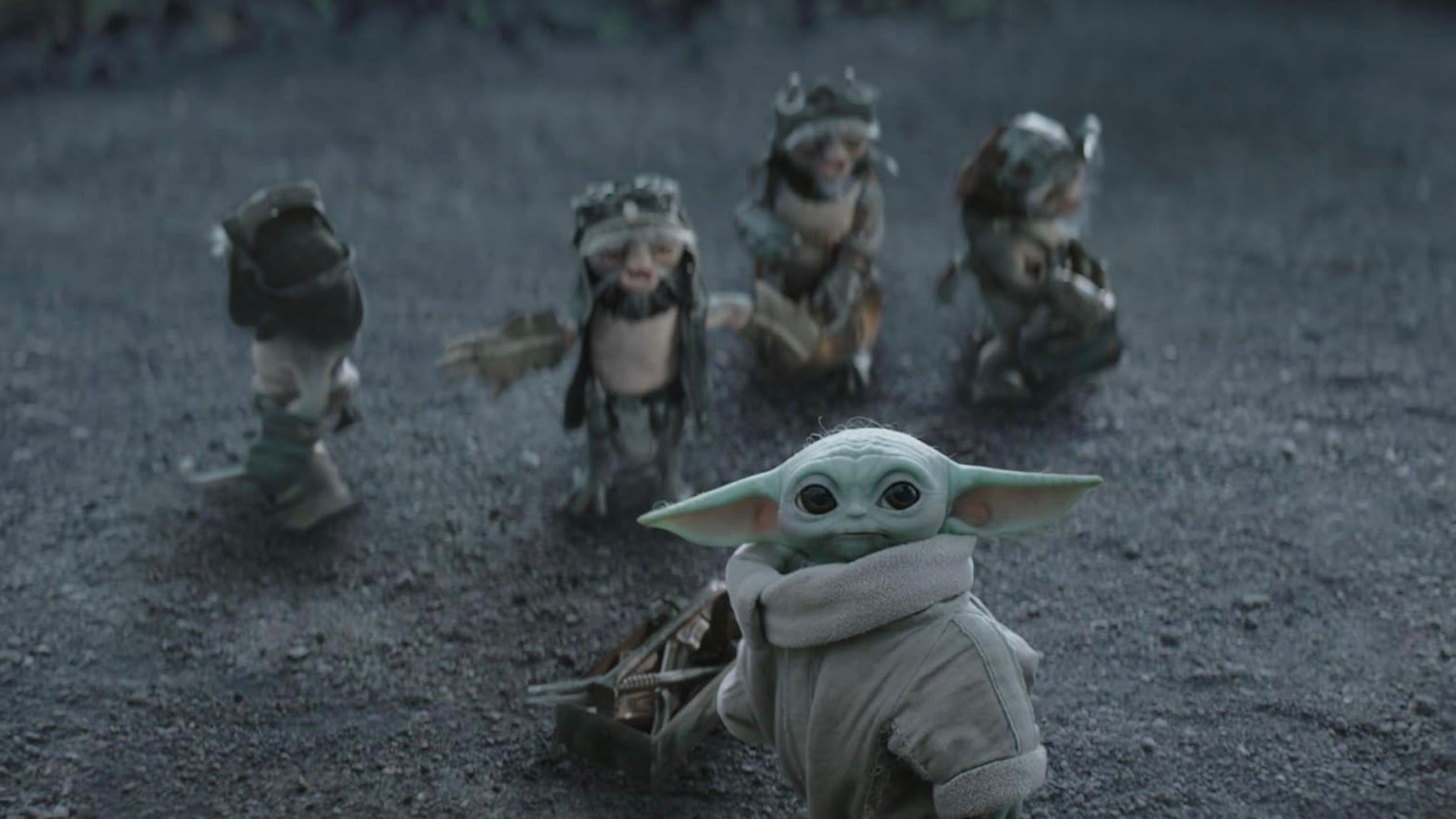
The film’s secret sauce is how it lives up to its title: if this goes beyond our traditional Mandalorian adventure, it’s because the “and Grogu” part really matters here. Grogu essentially takes over as protagonist at the halfway point for a good long stretch, and it’s lovely: a Jim Henson creature feature, à la The Dark Crystal or Labyrinth, mostly devoid of dialogue, as the little guy gets in the metaphorical driver’s seat and does some creative problem solving. It’s adorable, yes, almost criminally so, but it’s also doing another thing this series has avoided since the end of season 2: letting the character dynamics evolve. Grogu gets to be proactive here, and Mando gets to start trusting and relying on him in a way he hasn’t before. In some ways the changes are small and glacial, but that’s also what makes them meaningful, in the same way a child taking its first steps is both a relatively minor increase in physical capability and a major, unforgettable milestone. The arc here is subtle, but it’s real. In the film’s trailer, Mando tells us “the kid will live centuries beyond me; I won’t always be around to protect him.” That line is cut from the finished film, but I think it would be redundant, as that’s clearly the subtext of the adventure, the anxiety quietly weighing on Mando early in the film, the dynamic being paralleled with Rotta the Hut and his awful family who never let him be his own man. At the end, Mando lets Grogu sit in the literal driver’s seat. Baby steps. But for our often-silent protagonist and his nonverbal ward, those baby steps feel big. The more salient line Mando has here is “The old protect the young and the young protect the old; this is the way.” It’s a small message, pat even, especially for a film carrying the creative and commercial burden of ‘Star Wars’ on its shoulders. But from another point of view, is not that smallness a virtue? Isn’t it healthy, for the series as a whole, that instead of coming down to a galaxy-wide war, or the fate of a long family lineage, or a grand meta-statement on the place of the franchise within the modern media landscape, a Star Wars movie can instead offer a simple, matter-of-fact reflection on what it is to be a parent?
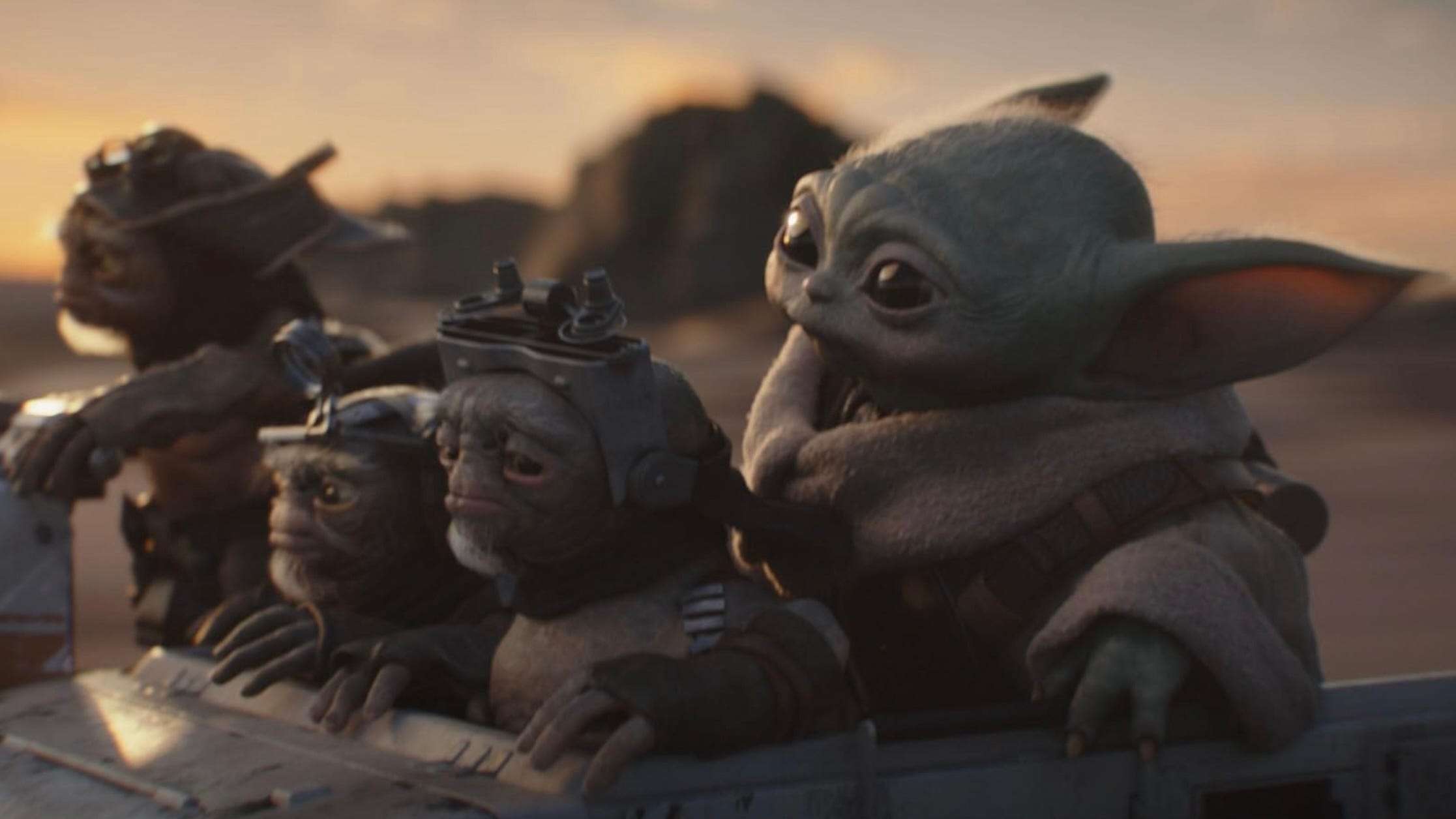
A lot of this will come down to how much you as an individual are A) into the basic procedural space western stylings of The Mandalorian to begin with, and B) how much you love Grogu in all his adorable puppet glory. If you’re a soulless curmudgeon who hates fun, then no, there is nothing to see here. Move along. You will be miserable, because this puppet is front and center and wielding his cuteness with the subtlety of a double-barreled shotgun. But if you love watching this awesome little puppet dude do funny little puppet dude things, then there’s a lot to love here. Again, that Jim Henson-esque stretch in the middle is lovely. Magical, even. I don’t think we should downplay the achievement of the practical puppet and animatronic work bringing this character to life just because we’ve seen it before; it’s truly extraordinary stuff, the kind of practical effects work we don’t see in Hollywood almost at all anymore, and every time the Lucasfilm team comes back to Grogu, they get a little better at it, are able to tease out more movement and expression and characterization. Honestly, my biggest complaint with The Mandalorian and Grogu is that too much of the rest of it relies on CGI for the alien characters, when we know this team is capable of such amazing tactile wonders. I can accept Rotta the Hut as a computer-generated creation, because he is big and ridiculous and has to body slam his opponents in a way that would probably wreck an animatronic; but none of that logic applies to Mando’s co-pilot Zeb, or the alien shopkeeper voiced by Shark Tale’s own Martin Scorsese. They should be puppets, and we should take joy in their tactility, too.
The production as a whole is solid, if never particularly elevated beyond what the TV series did. The cinematography is fine, but not on par with the standard set by legends Greig Fraser and Dean Cundey on the series. Their work had considerably more color and dynamism to it than most of what we see here; it’s never as bad as your average barely color-graded Marvel movie, but it also lacks the visual panache that typically accompanies Star Wars on screen. Normally, this would bother me more than it does; the theatrical film playing in IMAX venues with $25 ticket prices should not have shakier visuals than the straight-to-streaming TV show. But the film makes up for its production deficits in one big way, and it makes up for it so fulsomely that I can accept these flaws in the aggregate: and that lies in the truly outstanding musical score by the increasingly unstoppable Ludwig Göransson, who makes an absolute meal out of expanding his themes and sonic textures from the show into a fully-realized two-hour film score. I love how he both dives deeper into the electronic, industrial sounds of this world while also pulling back and engaging in some John Williams-style orchestral whimsy. The stretch with Grogu in the lead is accompanied by a really different kind of score than we’ve heard from Goransson before, one that borrows from Williams not in the big bombastic attention-grabbing motifs, but in the quieter moment-to-moment way Williams’ symphonic scores dance above the action, acting as a sonic extension of the mise-en-scene. That’s the part of Williams that’s always missing when others try to imitate him (it’s the part Michael Giacchino is terrible at, in his abysmal scores for Rogue One or the Jurassic World movies), but arguably the element that’s most important. And it’s a joy to hear how Goransson shifts in and out of those different modes depending on which of our two leads is in the figurative (or literal) driver’s seat.
So yes – my response to The Mandalorian and Grogu is positive, though not rapturous. If anything, the fact that I can walk into a Star Wars movie and simply have a good time with it, without feeling the need to declare it a harbinger of something greater in one direction or the other, is I think a healthy sign for this franchise. I understand, to some degree, why much of the critical reaction has been hostile – this is the first Star Wars film that is not trying to be ‘an event,’ and if you’re going in expecting one, it will absolutely throw you for a loop – but at the end of the day, this film is exactly what it says on the tin: It is The Mandalorian, as a movie, this time with more Grogu. There’s nothing wrong with that; if anything, Star Wars has needed something like this, something smaller and less obsessed with legacy and lore, something that reminds us why this is a ‘universe’ in the first place, one with many potential corners, not just one grand narrative that must be followed and chronicled obsessively. This might not be the way, but it is a way; that Star Wars can relinquish its grip on the definite article in the scope of its ambitions is, I posit, a step in the right direction.
Read the book 200 Reviews by Jonathan R. Lack in Paperback or on Kindle
Subscribe to PURELY ACADEMIC, our monthly variety podcast about movies, video games, TV, and more
Like anime? Listen to the podcast I host with Sean Chapman, JAPANIMATION STATION, where we review all sorts of anime every week. Watch on YouTube or Subscribe wherever you get your podcasts.
Not the first Star Wars film ever, though, since it has this quality in common with the animated The Clone Wars movie from 2008 (essentially the pilot for the subsequent 7-season TV show).
Yes, Tony Gilroy’s Andor stands outside this reading of recent Star Wars history; but then, it stands outside – and, frankly, above – most of Star Wars history to begin with. It’s special.
Doug you missed the entire point of the article. anyways. I completely agree with your article. if you came into this thinking you were going to get anything more than an extension of the tv series you were bound to be disappointed. I think it did everything it was supossed to do. and definitely made up for the missing time we got with mando and grogu from season 3. Also I definitely think watching the movie on a smaller screen makes up for the quality of the movie. since I finished the series for a second time right before watching the movie I could tell there was a lot of improvements upgrades and better quality than the show. I agree there should have been more puppets. Im disappointed that it was a movie and not a season 4 though. I really loved the series and a season 4 focused on just mando and grogu would have been a perfect redirect back to the main characters. I heard someone say that they got sick of grogu after a while and I dont even get that. the whole dynamic IS both of them together. if you dont like that then watch the other 500 series disney put out. I personally was not able to truly get into the franchise until this series came out. its perfect for people who are more light hearted and whimsical with some bad a$$ moments. i feel like people are trying to gate keep what starwars is now which we all already knew wasnt a thing after Disney bought Lucasfilms so why are people still putting the weight of the original trilogy on whats supossed to be a fun side quest. it was never supossed to be so uptight. I now have a deeper love and appreciation for the whole universe of star wars more than I ever could have without the mandalorian. Dont get me wrong they definitely saw how popular grogu was and ran that into the ground, but thats seperate from the series. Im really sad how many people are hating this series and movie because again its the only reason im even half intrested in the star wars universe. I think people are just mad at disney for a bunch of other things and are using this series as a scapegoat.
Who the hell wants small stakes Star Wars? Star Wars isn't supposed to be small. It's mythic Wagnerian Space Opera. This was lazy, boring and phoned in. The puppet work was more impressive when I saw the Muppets Take Manhattan 40+ years ago. Are you really forgiving this corporate slop because they had 10 minutes of puppets? What about Rotta the Hutt's ever changing shape and size. A climax with 3 blobby things wrestling on the floor for no stakes at all! What a mess.